Rivul Deep Research
Agentic AI research with the evidence still attached.
Search scholarly literature through Rivul Index, let an AI research workflow organize the next steps, inspect the sources it used, and carry verified findings into a cited draft in Rivul AI.
Rivul AI currently supports scholarly search, grounded research, source review, cited writing, and export. Expanded autonomous reports and monitoring remain product direction.
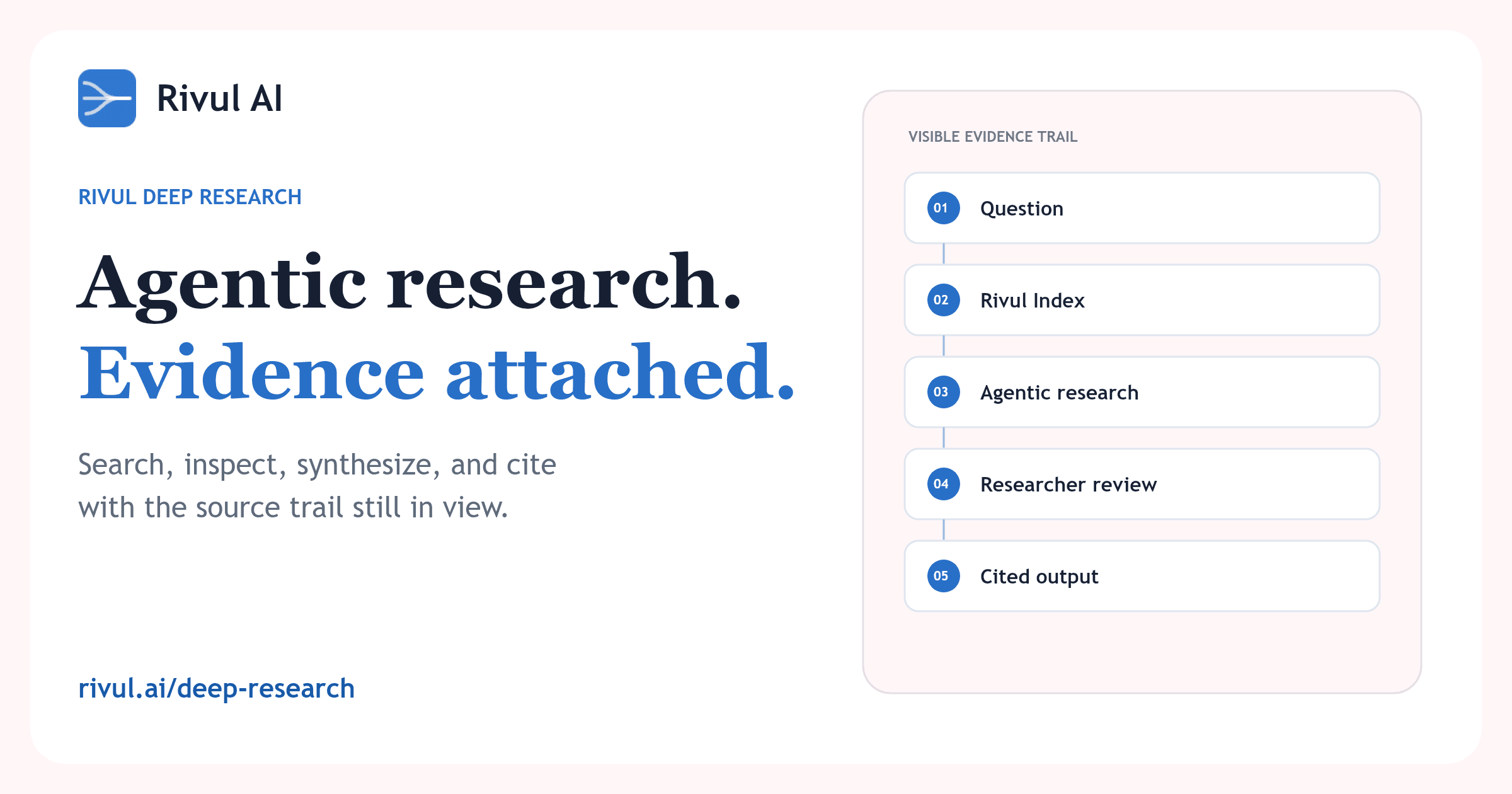
- 01QuestionA bounded research task
- 02Rivul IndexScholarly records and source links
- 03Agentic researchSearch, refine, compare, and organize
- 04Researcher reviewRead, challenge, and approve
- 05Cited outputA draft with traceable references
Retrieval log · source records · cited passages
What deep research means here
More than a long answer. A research process you can inspect.
Agentic AI research becomes useful when it can do more than generate prose: it must decide what to search, gather relevant scholarly records, compare evidence, expose uncertainty, and show the researcher where every important claim came from. Rivul Deep Research is designed around that visible chain.
The research loop
Search, investigate, verify, and write.
Search through Rivul Index
Find academic and scientific papers through Rivul AI's private scholarly search engine, then retain the title, authors, year, DOI, venue, and source location used in the research trail.
Run bounded agentic steps
Break a broad question into searches, inspect candidate papers, compare findings, and refine the next step. Each stage should stay narrow enough for a researcher to review.
Keep evidence beside the answer
Separate what was retrieved from what was cited. Open the paper or available source text before accepting a synthesis or moving it into the manuscript.
Draft with traceable citations
Carry reviewed findings into Rivul AI with their source records attached, then check claims, manage the bibliography, and export the manuscript.
The Rivul AI research stack
One evidence layer, three ways to work.
Each product serves a different research context while Rivul Index supplies the scholarly foundation.
Rivul AI
The researcher workspace for finding papers, reading sources, asking grounded questions, writing with citations, checking claims, and exporting manuscripts.
Explore Open ResearchRivul Atlas
The REST API and MCP server that lets software and AI clients search scholarly records and return structured citation metadata with source links.
Explore Rivul AtlasRivul Intelligence
The planned layer for reproducible landscape reports, research monitoring, and organizational workflows built on source-linked evidence.
See the product directionRivul Index
The private scholarly search and metadata engine beneath Rivul AI research and Rivul Atlas. It returns records and source locations; it does not turn metadata into proof by itself.
Review data sourcesResearch boundary
The agent can continue the search. The researcher owns the conclusion.
A source-linked workflow can reduce repetitive searching and organization. It cannot decide whether a study is valid, whether a method fits your question, or whether a passage supports your final wording. Rivul AI keeps those decisions visible instead of hiding them behind a finished answer.
Questions
Rivul Deep Research FAQ
What is Rivul Deep Research?
Rivul Deep Research is Rivul AI's evidence-first approach to multi-step AI research. It connects scholarly search, source review, synthesis, citations, and drafting while keeping the research trail visible to the researcher.
What makes deep research agentic?
An agentic research workflow can plan and perform several bounded steps, such as forming searches, reviewing candidates, comparing evidence, and deciding what to investigate next. The researcher still reviews the sources and controls the final claims.
How does Rivul Index support deep research?
Rivul Index is Rivul AI's private scholarly search and metadata engine. It supports discovery and returns source-linked records that can be inspected before a paper is used as evidence.
What are Rivul Atlas and Rivul Intelligence?
Rivul Atlas is the current REST API and MCP server for read-only scholarly search by software and AI clients. Rivul Intelligence is the product direction for reproducible research reports, monitoring, and organizational research workflows; those capabilities are not presented as generally available today.
Does Rivul Deep Research replace reading research papers?
No. AI can help locate, organize, and compare evidence, but the researcher must read the relevant source, evaluate its methods and limitations, and confirm that it supports the final wording.
Start with the evidence